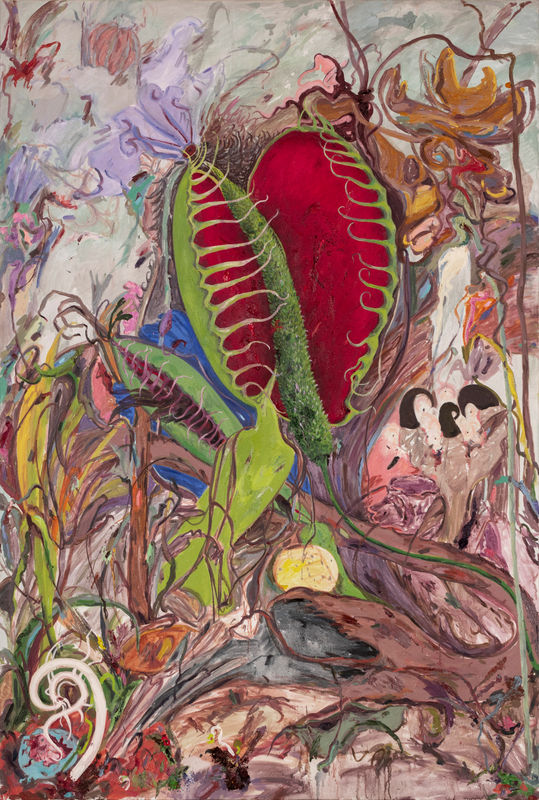
Born and brought up in the hilly tropics of Assam, Manmita Ray’s practice emerges from a sustained engagement with nature and organic forms. Collecting twigs, seeds, shells, and vegetal fragments, which she draws back to her childhood, is an integral methodology of her practice. Beyond merely representing nature, her work depicts the significantly entangled plant and animal kingdoms. Ray’s childhood habit of collecting twigs, seeds, shells, and vegetal fragments becomes, in her mature practice of attunement – a method of an archaeological and palaeontological nature. This approach makes her artistic practice where the boundaries between biological memory, ecological loss, and human intervention blur.
Ray’s artistic world is one of surreal abundance, where foraged organic forms, primarily botanical, tangle into ecosystems that are strange and familiar at the same time. The visual world often evokes a sense of paleo botanical strata, where organic forms exceed evolutionary time and appear to be on the brink of disappearance or surfacing from the epochs. The compositions, tangled and iridescent, hover between the familiar and the alien, echoing the surreal botanical imaginaries. The faint animality that haunts the forms underscores the interpenetration of species and the time trajectories that bind them. Through this, Ray’s practice subtly addresses the ecological collapse, extinction, and the fragility of sensitive ecosystems at the cusp of disappearance. The botanical image, once instrumentalised for colonial classification and scientific extraction, is reconfigured here as a gesture of care and reclamation. Ray’s practice resists the taxonomic impulse of historical botanical illustration and instead proposes a reparative, imaginative ecology that reconstructs worlds that have receded or mutated under the ecological shifts and climate change.
Ray uses beeswax, ink, oil, and clay as her primary mediums. Her fascination with encaustic painting began during her formative years at Kala Bhavana, Visva-Bharati, Santiniketan. The fragrant presence of beeswax generates a subtle haptic presence around the work. The viscosity and translucence of wax amplify the luminosity of her forms, creating a depth that mirrors the layered and embedded realms in them. In bringing together sensory tactility, ecological consciousness, and speculative natural history, Ray’s practice positions itself within contemporary conversations on the aesthetic and ethical dimensions of the Anthropocene. They operate in the dual space of mourning the loss of ecologies and imagining the new and complex organic worlds that continue to shape and haunt our collective imagination.
